
“You saw me before I was born. Every day of my life was recorded in your book.” — Psalm 139:16 (NLT)
It was 1966 in what was then a small East Bay city in Northern California. A quiet place with just one traffic light, one hospital, and a population small enough that everyone still seemed to know each other. Life moved a little slower, and modern medicine hadn’t yet caught up to what we now take for granted.
My parents were young—just kids when they met in high school. Like many of their generation, they married straight after graduation and started building a life together. My dad began working at Peterbilt Motors at 18 and quickly rose through the ranks, becoming plant manager by the time I was born. My mother, precise and driven, had gone to beauty college and poured her perfectionism into her craft. They were hardworking, blue-collar dreamers who moved to Fremont, California, chasing opportunity and the promise of a good life.
When my mother became pregnant with me—her second child—there was very little in the way of prenatal care. No ultrasounds. No routine screenings. Pregnancy in those days was more mystery than science. You simply hoped for the best, trusted your doctor, and waited.
Her labor was long and exhausting. But once I arrived, something was wrong. The delivery room didn’t erupt with the usual joy or cheerful announcement. There was no “Congratulations! It’s a girl!” Just hushed voices. Whispered conversations. And worst of all—silence.
My mother lay there, confused and increasingly panicked. Where is my baby? she cried, her voice cracking with fear. Was the baby missing limbs? Was something horribly wrong? No one was answering her. No one offered reassurance. The delivery room was filled with whispers, not explanations.
She tells me now—decades later—that those moments felt like an eternity. What was probably only minutes felt like hours as her mind spiraled into the darkest possibilities. She was completely alone in her fear, with nothing to hold onto except mounting dread. And to this day, she cannot tell the story without tears. No matter how much time has passed, the trauma of being kept from her baby—of being left in silence and uncertainty—has stayed with her. It marked her deeply, in a way that words can’t fully express. The grief, the helplessness, the aching unknown—it still lives in her voice whenever she recounts that day.
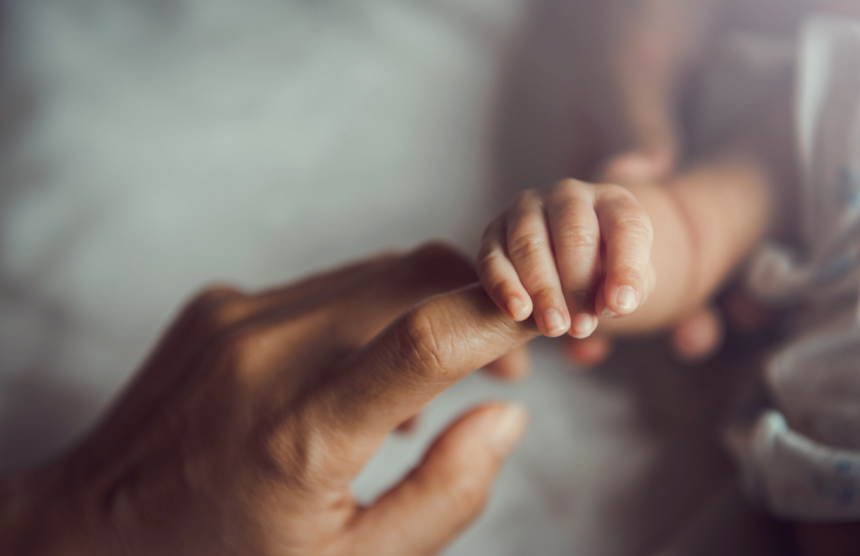
So when they finally brought me to her—wrapped tightly in a hospital blanket—her relief, while incomplete, was immense. Even in the face of visible imperfection, she felt a sense of grounding. The worst fears hadn’t come true. There was brokenness, yes—but there was also beauty. There was life. She didn’t yet know what was ahead, but in that moment, she could hold her baby. And that moment mattered.
The reasons for her relief—the complexity of what she saw, what she feared, and what she hoped for—will unfold slowly as my story continues.
While she was grappling with shock and grief in that delivery room, my father waited in the designated room for expectant fathers—a space where dads sat quietly, trading small talk, pacing, or sipping bad coffee while the mysteries of childbirth unfolded behind closed doors. It was routine back then for fathers to be kept at a distance, but this time felt different. He knew something was wrong.
This wasn’t how it had gone with their first child. There was no beaming doctor coming through the door with a proud announcement. No nurse inviting him to the nursery for a first look. No one ushering him into my mother’s room with congratulations. Just silence. And waiting.
He didn’t know what was happening—but he knew it wasn’t right.
I don’t know many details about my father’s reaction in those early moments. Like many men of his generation, he didn’t speak much about emotional things—especially when they were painful. But I can imagine it now, as a parent myself: the uncertainty, the helplessness, the fear. Whatever he felt that day, I know it marked him. Just as it did my mother. Just as it would eventually mark me.
While my parents were still reeling from the shock of my birth, there was little time to process what was happening. My mother didn’t stay in that small-town hospital long. In fact, she left abruptly—accompanying me to what was then Oakland Children’s Hospital. I’m not sure how we got there, whether she drove or someone else did. But somehow, we arrived. And that’s where my parents began to learn the full scope of what they were facing.
Doctors explained the nature of my rare birth defect in greater detail. My bladder was completely exposed and sitting outside my body. My pelvic bones were splayed. There was uncertainty about the internal structures, and an overwhelming awareness that this would be only the beginning. I would need multiple surgeries, a team of specialists, and years—possibly a lifetime—of medical care.
It was so much more than anyone expects when welcoming their second child.
But my mom always says the same thing when she tells the story: You were just beautiful.
She knew I was a girl the moment she saw me. Not because anyone told her, but because she just knew. And in the middle of all the unknowns, that certainty grounded her.
As she waited for answers in that delivery room, her mind had gone to the worst places. She imagined I might be missing limbs or struggling to survive. So when she finally saw me—imperfect, vulnerable, yet whole in her eyes—she saw beauty.
Leave a Reply